An industrial water treatment plant prepares raw water for a defined use by controlling contaminants such as iron, manganese, hardness and suspended solids. A commercial building’s drinking-water supply, a factory’s process water and a boiler’s feedwater do not have the same treatment requirements.
Groundwater and borewell water can contain dissolved iron, manganese, calcium and magnesium salts, turbidity, organic compounds, colour and odour. Surface water and stored water present different challenges. Clear-looking water can still contain dissolved contaminants that a mechanical filter will not remove.
As a water treatment plant manufacturer in India, Technochem designs industrial and commercial systems around the raw water analysis, required flow and treated-water objective. Vessel dimensions and media are engineering decisions—not an arbitrary combination of standard tanks and filter materials.
Engineering insight / 01
Engineering the vessel around flow and media
Filter vessel diameter is calculated from the design flow and the service velocity suitable for the selected media. Technochem starts with the selected pump’s operating flow at the actual system head, checks the required production rate, and determines the filtration area.
D = √(4 × Q / (π × SV))
| Symbol | Meaning | Unit |
|---|---|---|
| D | Required internal vessel diameter | m |
| Q | Design flow through one operating filter | m³/hr |
| SV | Selected filtration service velocity | m³/hr/m², equivalent to m/hr |
The relationship follows from filter area A = Q / SV and circular area A = πD² / 4. For parallel vessels, use the design flow assigned to each vessel and check duty/standby or backwash operating conditions.
As an arithmetic illustration only, Q = 10 m³/hr and an assumed SV = 10 m/hr give A = 1 m² and D ≈ 1.13 m. This is not a recommended service velocity or a complete vessel specification. A different medium or raw water quality can require a different filtration area.
There is no universal filtration velocity
The appropriate velocity depends on the filtration process, media characteristics, contaminant loading, required outlet quality and the media manufacturer’s operating limits. A hydraulic flow rating alone does not establish iron-removal performance or sufficient adsorption contact time. The pump must also overcome the clean and dirty-bed pressure losses without exceeding the selected operating flow.
Diameter is only the first design step
After calculating diameter, Technochem selects vessel height, effective media bed depth, gravel support where required, freeboard, inlet distribution and underdrain arrangement. Freeboard accommodates bed expansion during backwash; distributors must spread flow and retain media without excessive pressure loss.
Operating pressure, pressure rating, construction material, corrosion protection, access for servicing, valves and instrumentation are checked together. Backwash flow is calculated separately from the media’s required expansion rate and water temperature. Available backwash water, drain capacity and pump head must be adequate. Uniform hydraulics help prevent channeling, media carryover and incomplete bed cleaning.
Engineering insight / 02
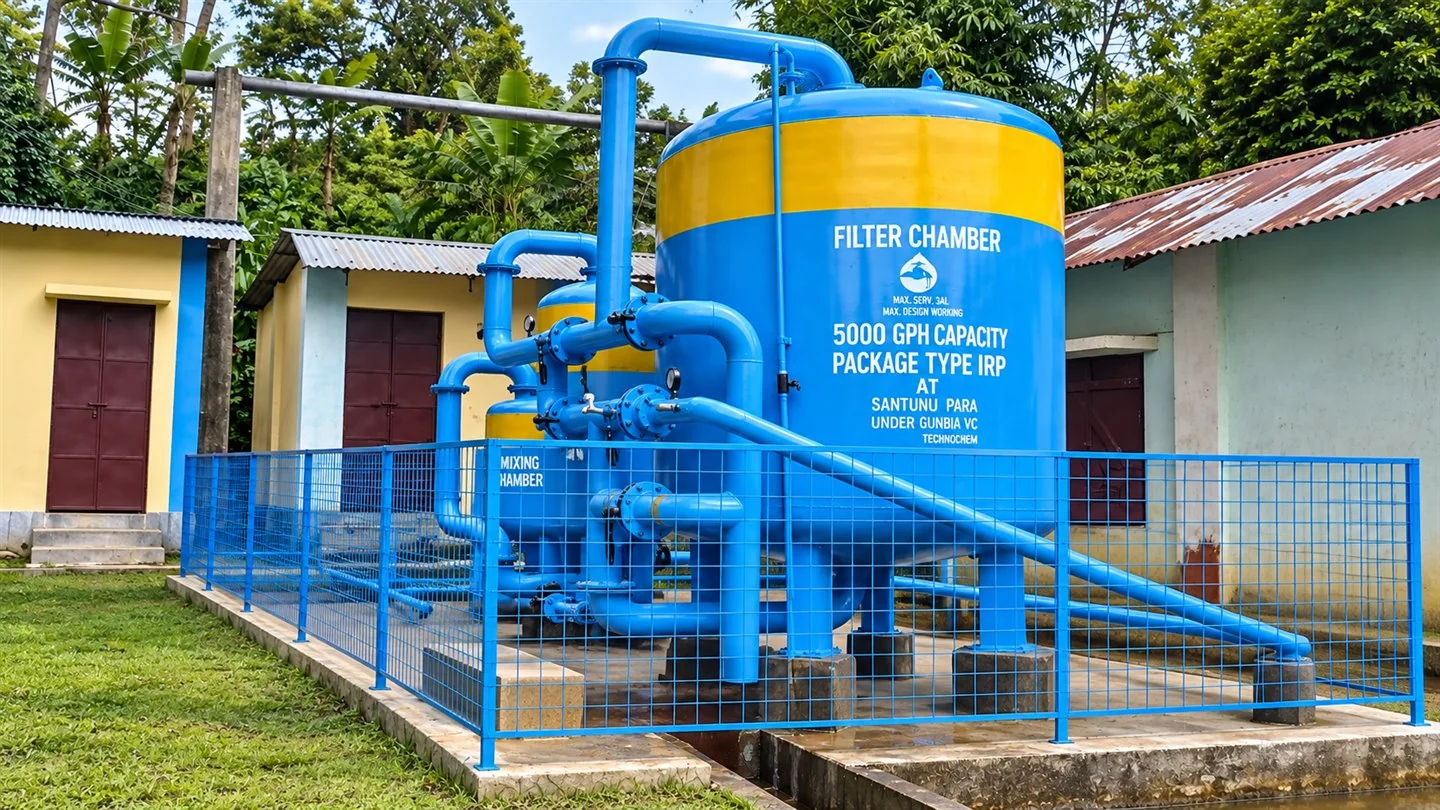
Iron removal plants for groundwater and borewell water
An Iron Removal Plant (IRP) removes iron using treatment matched to its dissolved and particulate forms. Groundwater can dissolve iron from geological formations under low-oxygen conditions. Iron can also enter water through corrosion in distribution systems.
Excess iron may produce yellow, reddish or brown water, stain fixtures, form pipeline deposits, clog filters, foul RO membranes and interfere with manufacturing or washing processes. Iron concentration alone is not enough to select a treatment system.
Ferrous and ferric iron behave differently
Ferrous iron, Fe²⁺, can remain dissolved and pass through a conventional mechanical filter. Oxidation converts it to ferric iron, Fe³⁺, which can form insoluble ferric hydroxide under suitable conditions. Filtration then captures the particles. Organic complexes and very fine colloids may require additional treatment. The Drinking Water Inspectorate’s iron and manganese guidance explains the distinction between oxidation and subsequent solids removal.
Conventional sand-and-gravel iron removal
A conventional iron removal filter can use a sand bed above a gravel support layer. Sand retains adequately oxidised iron particles; gravel supports the bed and assists distribution in a compatible underdrain design. Backwashing lifts and cleans the bed so the captured solids leave through the waste line.
This arrangement can suit appropriate iron loading and water characteristics when oxidation and filtration conditions are adequate. Sand and gravel alone should not be presented as a reliable removal barrier for all dissolved iron. Severe solids loading can require upstream separation as well as filtration.
Technochem’s preliminary media-selection guidelines
The following are Technochem’s preliminary screening guidelines, not universal standards, guaranteed treatment limits or automatic product selection rules. In dilute water, 1 ppm is approximately 1 mg/L; confirm the laboratory’s reporting basis.
| Raw water iron concentration | Preliminary treatment option | Required qualification |
|---|---|---|
| Below 1 ppm | Conventional MnO₂-based media | Verify media grade, pH, oxidation conditions and backwash requirements |
| Above 1 ppm | Katalox Light media | Check total loading, manganese, oxidant demand and supplier limits |
| Above 3 ppm | ISR resin-based treatment may be evaluated | Verify the exact resin, water analysis, iron speciation and supplier suitability |
The above-1 and above-3 ranges overlap intentionally: exceeding 3 ppm triggers an additional resin or alternative-treatment evaluation, not a mandatory switch. At the 1 and 3 ppm boundaries, treatment is selected from the full analysis rather than an artificial cut-off.
Final selection considers dissolved ferrous and oxidised ferric iron, manganese, pH, turbidity, organic matter, oxidant demand, overall chemistry, required outlet quality and the media manufacturer’s technical specifications. Trials may be necessary where chemistry or loading is uncertain.
MnO₂-based media and Katalox Light
Manganese dioxide filter media can support catalytic oxidation and capture of iron and manganese under suitable conditions. MnO₂-based products differ in composition, density and operating requirements; pH, oxidant availability and backwash capability must match the actual grade.
Katalox Light is a proprietary MnO₂-coated filtration medium, so it is not a separate chemical category from all manganese-dioxide media. Technochem may consider a Katalox Light filter for iron and manganese removal where its characteristics suit the water. Correct pretreatment, bed depth and backwashing remain essential; higher raw iron does not by itself prove suitability. See the manufacturer’s Katalox Light information for product-specific conditions.
Specialised iron removal resin
ISR refers here to a proposed specialised iron removal resin option. Its exact supplier, grade, removal mechanism, capacity, allowable iron forms, regeneration method and operating limits must be confirmed for the project. It is not automatically suitable for every source above 3 ppm iron.
Do not assume a resin designed for dissolved iron can accept precipitated ferric solids or residual oxidants. Where oxidation is used ahead of a resin, verify compatibility and provide the required solids removal or oxidant control. Conventional oxidation and filtration, with additional solids handling where necessary, may be a more appropriate alternative.
When an oxidation stage is required
Oxidation changes dissolved iron into a form that can be filtered; filtration removes the resulting suspended particles. A separate oxidation arrangement may be needed where the available oxygen, contact time or selected media cannot achieve the required conversion, particularly with higher iron loading.
Depending on water chemistry, the arrangement may use aeration or suitable chemical dosing followed by a contact tank. Oxidant demand includes substances other than iron. Dose, mixing, pH, available alkalinity and contact time must therefore be established together, with control of any residual oxidant before sensitive downstream equipment.
Not every IRP needs a separate oxidation filter. Some catalytic systems combine oxidation and filtration within a suitable operating envelope. Iron speciation, manganese, dissolved oxygen, pH, media properties and the treatment objective determine whether an additional stage is required.
High turbidity and anthracite filtration
An anthracite filter layer above sand and gravel can form a multimedia bed for suitable higher-turbidity applications. The coarser upper layer provides space for solids capture before finer filtration deeper in the bed. Media size and density must be selected to maintain the intended layering after backwash.
Anthracite is not required in every IRP and does not replace oxidation of dissolved iron. Very high turbidity or difficult colloids may require coagulation, clarification or another upstream process; adding another media layer is not always enough.
Activated carbon after an IRP
An Activated Carbon Filter (ACF) may follow an IRP to adsorb selected organic compounds and reduce associated colour and odour. Removing iron solids first helps avoid unnecessarily loading the carbon bed. Carbon can also support dechlorination where the selected grade and contact time are suitable.
Activated carbon does not remove every organic contaminant, is not a general dissolved-salt removal system, and does not replace iron removal or softening. Carbon grade, bed depth, contact time and replacement or off-site regeneration needs depend on the application. Backwashing removes accumulated solids; it does not restore exhausted adsorption capacity. Monitor breakthrough and maintain hygienic operation, particularly where residual disinfectant is removed. The EPA overview of treatment technologies describes the role of granular activated carbon.
Engineering insight / 03
Water softening plants and hardness control
A water softening plant reduces dissolved calcium and magnesium, the principal hardness-forming ions. Hardness can contribute to deposits in pipelines, heat exchangers, boilers and cooling systems, reduce heat transfer, increase maintenance and create scaling risks for RO membranes. Actual scale formation depends on temperature, concentration and water chemistry as well as hardness.
Sodium-cycle ion exchange and 225 NA resin
Technochem uses 225 NA softener resin for suitable applications. In a sodium-cycle cation exchanger, the resin exchanges sodium ions for calcium and magnesium ions as water passes through the bed. The resin’s usable operating capacity is gradually consumed by the incoming hardness load.
The selected 225 NA grade, working capacity and oxidant tolerance must be checked against its current supplier data. A total laboratory exchange capacity is not the same as the usable capacity at a chosen salt dose and outlet-hardness target. Ion Exchange’s softener guidance describes sodium exchange and brine regeneration; its INDION resin portfolio provides grade-specific information.
Raw Water → Pretreatment (if required) → Softener Vessel → Treated Soft Water
Service and regeneration cycle
- Service: the resin captures hardness until the specified operating capacity or outlet-hardness limit is approached.
- Backwash: the bed is cleaned and redistributed as required by the vessel and regeneration design.
- Brine regeneration: sodium chloride brine supplies sodium ions that displace retained calcium and magnesium.
- Slow rinse: controlled rinsing completes regenerant displacement through the bed.
- Fast rinse: residual brine is removed and the outlet is checked before returning to service.
Regeneration details vary with co-current or counter-current equipment. Brine concentration, flow and rinse volumes must follow the selected design. Regeneration wastewater contains salt and removed hardness and needs an appropriate collection and disposal arrangement.
A sodium-cycle softener does not substantially remove total dissolved salts: it exchanges hardness ions for sodium. Soft water is not demineralised water. Where dissolved-salt reduction is required, evaluate a reverse osmosis plant or other suitable demineralisation process. Softening alone also does not establish drinking-water or microbiological safety.
Softener sizing needs hydraulic and capacity calculations
Technochem determines softener vessel dimensions and resin volume from both service flow and hardness loading. A vessel selected only from pump flow can have insufficient resin capacity and need excessively frequent regeneration.
The design accounts for incoming hardness, allowable treated hardness, daily demand, operating hours, resin service rate and usable capacity, regeneration frequency and salt consumption. As a loading relationship, volume treated in m³ multiplied by hardness removed in mg/L as CaCO₃ gives grams of hardness as CaCO₃ per service cycle. Divide that load by the selected working capacity in g CaCO₃ per litre of resin to estimate the resin requirement, then check hydraulic limits and operating reserve.
Iron, suspended solids or incompatible oxidants may require pretreatment to protect the resin. Continuous supply can require duty/standby or alternating vessels so regeneration does not interrupt production. Boiler and cooling-water specifications may require treatment beyond softening.
Engineering insight / 04
Pressure sand, activated carbon and multimedia filters
An industrial filtration system combines distinct treatment duties. The correct sequence follows the raw water report and intended application, not a fixed catalogue order.
| System | Main duty | Important limitation or design check |
|---|---|---|
| Pressure Sand Filter (PSF) | Retains suspended solids, reduces turbidity and protects downstream equipment | Does not generally remove dissolved salts or unoxidised dissolved iron |
| Activated Carbon Filter (ACF) | Adsorbs selected organic compounds, reduces associated colour and odour; dechlorination where suitable | Requires adequate contact time and monitoring for exhaustion; not a softener |
| Multimedia filter | Uses graded layers such as anthracite, sand and supporting gravel for solids filtration | Layer sizing, backwash expansion and raw-water solids characteristics determine performance |
| Water softener | Exchanges hardness-forming calcium and magnesium for sodium | Regeneration capacity and salt demand matter; not a TDS-removal process |
Engineering insight / 05
Illustrative treatment configurations
These process flows illustrate possible arrangements. They are not universal designs or evidence that every listed stage is needed. Oxidation, carbon, softening, disinfection and other steps may be rearranged or supplemented after laboratory analysis and downstream-equipment review.
Groundwater with low iron
Raw Water Tank → Oxidation (if required) → IRP with suitable MnO₂-based media → ACF (if required) → Treated Water Tank
Confirm that pH, oxidation conditions and the selected medium suit the dissolved and particulate iron fractions, even at low total iron.
Groundwater with higher iron
Raw Water Tank → Oxidation and Contact Stage → IRP with suitable Katalox Light or other selected media → ACF (if required) → Treated Water Tank
Check oxidant demand, iron-solids loading, filter run length and available backwash flow. Additional solids separation may be required.
High iron loading: treatment selected after analysis
Raw Water Tank → Suitable Oxidation and Contact Stage → Solids Removal / Selected Iron Removal System → Polishing Filtration → Treated Water Tank
Specialised ISR resin may be considered as an alternative treatment route, or within a compatible pretreatment train, only after its feed specifications are verified. Oxidised iron must not simply be directed into a resin intended for dissolved iron. Supplier approval determines whether oxidation, upstream solids removal or oxidant removal is required or incompatible.
Hard water
Raw Water Tank → Pretreatment (if required) → Water Softener with suitable 225 NA Resin → Soft Water Tank
Size the resin for hardness load and cycle length as well as flow, and provide the required brine and regeneration-waste arrangements.
Water containing iron and hardness
Raw Water Tank → Oxidation (if required) → Iron Removal Plant → ACF (if required) → Water Softener → Treated Water Tank
Iron control upstream helps protect the softener. Carbon is included only for a defined duty, such as suitable organic removal or oxidant control. Final disinfection or membrane treatment may be necessary for the intended use.
Engineering insight / 06
Applications across industrial and commercial facilities
Treatment targets vary with use. Manufacturing, engineering and automobile facilities may need filtration for process water and conditioned water for utilities. Textile and dyeing facilities may require iron control, softening and suitable process-water purification. Food and beverage facilities must assess process and hygiene requirements as well as source-water chemistry.
Pharmaceutical and chemical facilities require water quality defined for the specific process; a standard filter or softener alone should not be described as producing validated pharmaceutical-grade water. Hospitals, healthcare facilities, hotels and commercial buildings can need different treatment trains for drinking water, utility water and specialist applications.
Boiler-feedwater pretreatment may include softening followed by further demineralisation, depending on boiler requirements. Cooling-tower makeup treatment must account for concentration cycles and the wider cooling-water programme. RO pretreatment may require coordinated iron, hardness and suspended-solids control. Read the RO engineering guide for membrane-system selection.
Raw water treatment is distinct from wastewater treatment. Technochem also provides industrial ETP systems for process effluent and STP systems for sewage; neither should be substituted for a raw-water treatment design without a defined reuse treatment objective.
Engineering insight / 07
Why a laboratory raw water report is essential
Raw water analysis determines treatment sequence, media selection, vessel sizing and operating requirements. Sampling should represent the source and its seasonal or operating variation. Record sampling conditions and distinguish dissolved from total iron where relevant; oxidation after sampling can change apparent iron speciation.
| Parameter | Why it matters |
|---|---|
| pH | Influences oxidation, precipitation and media performance |
| Iron, including dissolved and total fractions | Determines iron-removal duty and likely solids loading |
| Manganese | Influences media choice, oxidation and contact conditions |
| Total hardness, reported as CaCO₃ | Determines resin capacity and regeneration requirements |
| Turbidity and suspended solids | Determine filtration and possible upstream separation needs |
| TDS | Indicates dissolved mineral content and possible need for membrane treatment |
| Alkalinity | Influences buffering, pH stability and treatment chemistry |
| Chloride | Matters for intended water use and material compatibility |
| Silica | Matters for downstream RO and boiler applications |
| Organic matter | Can influence oxidation demand, iron behaviour and activated-carbon selection |
Additional tests, such as dissolved oxygen, oxidant residuals or microbiological parameters, are selected for the source and use. A laboratory report must be read together with peak and daily flow, pump duty, available pressure, site constraints and the required treated-water specification.
Engineering insight / 08
From enquiry to commissioned water treatment plant
Technochem’s engineering and manufacturing approach links vessel hydraulics, media behaviour and treatment objectives throughout the project.
- Define the application and required treated-water quality.
- Review the raw water laboratory analysis and source variation.
- Establish design flow from actual pump duty, production demand and operating hours.
- Select filtration service velocities appropriate to the process and media.
- Calculate internal vessel diameter, then establish height and freeboard.
- Select filtration media and resin against the chemistry and supplier limits.
- Determine media quantities, bed depths and support/distribution arrangements.
- Design backwash, regeneration, rinse and waste-handling requirements.
- Select pumps, valves, piping and monitoring instruments for the operating duty.
- Fabricate, assemble, install and commission the system, checking flow, pressure loss and treated-water results.
Commissioning should also establish operating settings, backwash or regeneration triggers and sampling arrangements. Operators need clear instructions for changes in raw water quality, differential pressure and outlet quality. A treatment vessel is only one component of a functioning plant.
Technochem’s existing locations are its Kolkata office at 148/A, Sodepur Road, Madhyamgram, Kolkata – 700129; factory at Khilkapur, Noapara, Barasat – 700125, West Bengal; and Tripura office at C/O Goutam Chowdhury, A. A. Road, Asram Chowmuhani, Agartala – 799001. Contact the team to discuss a water treatment project in India and its site requirements.
Engineering insight / 09
Frequently asked questions
What is an industrial water treatment plant?
It is a system that prepares raw water for a specified industrial use through processes such as oxidation, filtration, softening and, where needed, membrane treatment. The required outlet quality determines the treatment train.
How does an iron removal plant work?
Many IRPs oxidise dissolved ferrous iron into insoluble particles and capture them in a filter bed. Some selected media combine oxidation and filtration; specialised resin routes need separate suitability checks.
When is an oxidation filter required before an IRP?
An additional oxidation and contact stage is considered when the water chemistry or selected medium cannot achieve adequate iron conversion within the available conditions. It is not required for every IRP.
Which media is used for iron removal from borewell water?
Options include sand for adequately oxidised iron, suitable MnO₂-based media, Katalox Light and specialised resin where verified. Iron speciation, pH, manganese, turbidity and supplier limits determine the choice.
What is the difference between MnO₂ and Katalox Light media?
MnO₂ describes manganese dioxide chemistry used in several filter-media grades. Katalox Light is a particular proprietary MnO₂-coated medium. Compare their actual specifications rather than treating them as unrelated removal mechanisms.
When is an activated carbon filter required after an IRP?
An ACF can be included for selected organics, associated colour or odour, or suitable dechlorination. It is optional unless the water analysis and downstream application establish a specific carbon-treatment duty.
How does a water softening plant work?
A sodium-cycle resin exchanges calcium and magnesium for sodium. Once the working capacity is used, brine regeneration and rinsing prepare the bed for its next service cycle.
Which resin is used in an industrial water softener?
Technochem uses 225 NA resin for suitable softening applications. The exact grade, working capacity, regeneration conditions and feed-water limits are verified for the project.
Does a water softener reduce TDS?
No: sodium-cycle softening exchanges ions rather than substantially removing dissolved salts. RO or another appropriate demineralisation process is needed where the application requires dissolved-salt reduction.
How is the diameter of an iron removal filter calculated?
Use D = √(4 × Q / (π × SV)), with Q in m³/hr and SV in m³/hr/m². The result is internal diameter in metres. Bed depth, backwash duty and treatment performance still need separate checks.
Why is raw water analysis important before selecting a plant?
It identifies the contaminants and chemical conditions that determine treatment sequence, media compatibility and capacity. Flow alone cannot show whether a filter or softener will meet the required water quality.
Can an IRP and water softener be combined in one system?
Yes. A treatment train may remove iron before softening to protect the resin. Oxidant control, solids filtration and any additional polishing are selected to suit the analysis and downstream use.
Engineering insight / 10
Discuss your raw water treatment requirement
Looking for an industrial water treatment plant designed around your raw water quality? Contact Technochem for an engineered solution for iron removal, water softening and industrial filtration.
Share the laboratory report, required flow, daily demand, pump duty and intended application through the existing Contact Technochem section. Explore Technochem’s iron removal installations and the wider water treatment solutions before discussing the appropriate configuration.