
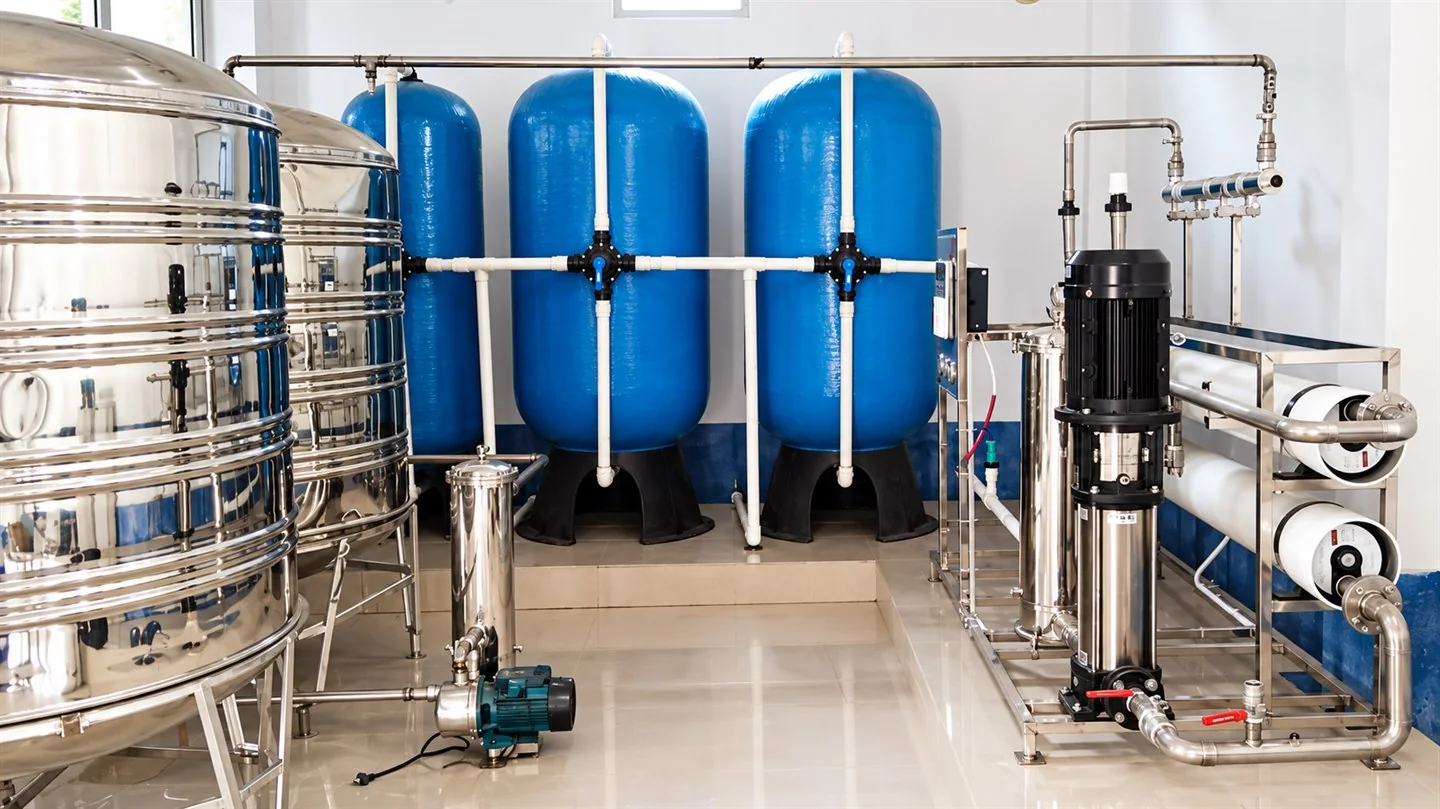
Engineered Water Purification Solutions Based on Raw Water Quality and Application Requirements
Water quality plays a critical role in industrial manufacturing, commercial operations and drinking water supply. However, the quality of available water varies significantly depending on geographical location, geological conditions and the source of water.
Groundwater may contain excessive dissolved salts, hardness, iron, manganese, fluoride, silica and other contaminants that make it unsuitable for direct use in manufacturing processes or drinking water applications.
Reverse Osmosis (RO) is one of the most effective technologies for reducing dissolved salts and producing purified water. It is widely used in industrial process water treatment, commercial water purification, drinking water systems, pharmaceutical applications and specialised water treatment processes.
At Technochem, we design and manufacture Reverse Osmosis plants based on the required treated water capacity and water quality specifications. Our approach begins with understanding the characteristics of the available raw water through laboratory analysis.
Although the fundamental RO process remains largely the same, the pretreatment configuration must be selected according to the actual groundwater characteristics. A water source containing high iron requires a different pretreatment arrangement from one containing excessive hardness, silica or suspended solids.
Technochem evaluates these parameters before finalising the filtration stages, chemical dosing requirements, membrane configuration and operating conditions.
Our capabilities include industrial RO plants, commercial water purification systems, drinking water treatment systems designed with reference to applicable BIS requirements, and specialised high-purity water treatment systems for applications such as dialysis and battery manufacturing.
Technochem – Engineering Water Treatment Solutions Around Actual Water Quality Requirements.
Engineering insight / 01
1. What Is a Reverse Osmosis Plant?
A Reverse Osmosis plant is a water purification system that uses a semipermeable membrane to separate dissolved salts, minerals and other contaminants from water.
During the process, feedwater is supplied to the RO membrane under pressure. The membrane allows water molecules to pass through while rejecting a significant proportion of dissolved salts and other impurities.
The treated water collected after passing through the membrane is known as permeate, while the concentrated stream containing rejected impurities is known as reject or concentrate.
A typical RO plant consists of raw water storage, pretreatment filtration, chemical dosing arrangements, cartridge filtration, high-pressure pumping, RO membranes, pressure vessels and treated water storage.
Basic RO Process:
Raw Water → Pretreatment → Cartridge Filtration → High-Pressure Pump → RO Membrane → Permeate Storage
The efficiency and reliability of an RO plant depend not only on the membrane but also on the quality of pretreatment, appropriate membrane selection and correct operating conditions.
Technical reference: DuPont’s reverse osmosis technology and membrane design resources.
Engineering insight / 02
2. Why Is Raw Water Analysis Important Before Installing an RO Plant?
Raw water analysis identifies the contaminants, scaling risks and fouling potential that determine pretreatment, membrane selection and operating conditions.
Two groundwater sources may have identical TDS values but completely different treatment requirements. One may contain high calcium and magnesium hardness, while another may contain elevated iron, manganese or silica.
Although both sources may require an RO plant, their pretreatment arrangements will differ.
Before designing a system, Technochem evaluates important parameters such as:
| Parameter | Importance in RO Plant Design |
|---|---|
| TDS | Determines the total dissolved salt concentration. |
| pH | Influences scaling potential and chemical treatment. |
| Total Hardness | Identifies calcium and magnesium concentration. |
| Iron | Can cause deposits and membrane fouling. |
| Manganese | May contribute to membrane fouling and deposits. |
| Silica | Can cause difficult-to-remove membrane scaling. |
| Alkalinity | Helps assess carbonate scaling potential. |
| Chlorides and Sulphates | Important for evaluating dissolved salt composition. |
| Turbidity | Indicates suspended particles requiring filtration. |
| SDI | Helps assess membrane fouling potential. |
| Fluoride and Arsenic | Important for drinking water treatment requirements. |
The laboratory report helps establish the pretreatment requirements, membrane selection, operating pressure and achievable recovery.
This prevents unnecessary treatment stages and helps protect the RO membranes against premature scaling and fouling.
Engineering insight / 03
3. Common Groundwater Problems and Their Pretreatment Solutions
The pretreatment system is one of the most important parts of an RO plant. Its primary purpose is to protect the RO membranes from scaling, fouling, suspended particles and chemical contamination.
Depending on the groundwater analysis, Technochem incorporates suitable pretreatment technologies.
3.1 High Hardness
Groundwater containing excessive calcium and magnesium can cause mineral scaling on RO membrane surfaces. This can reduce permeate production, increase operating pressure and shorten membrane service life.
Treatment approach: Water softeners, suitable antiscalant dosing and controlled RO recovery, depending on the water chemistry.
3.2 High Iron and Manganese
Iron and manganese are commonly found in groundwater. Under suitable oxidation conditions, dissolved iron and manganese can form deposits that accumulate on filtration media and membrane surfaces.
Treatment approach: Suitable oxidation followed by iron and manganese removal filtration using appropriate filtration media.
3.3 High Silica
Silica is a particularly important parameter in RO plant design because it can form difficult-to-remove deposits within the membrane system.
Excessive silica concentration may restrict the achievable recovery and increase membrane scaling risks.
Treatment approach: Appropriate antiscalant selection, recovery optimisation and additional treatment where necessary.
3.4 High Turbidity and Suspended Solids
Suspended particles can accumulate on membrane surfaces and cause fouling.
Treatment approach: Pressure Sand Filtration, clarification or other suitable pretreatment followed by cartridge filtration.
3.5 High Organic Content
Certain organic compounds can contribute to membrane fouling and affect system performance.
Treatment approach: Activated Carbon Filtration and other suitable organic removal processes, depending on water characteristics.
3.6 High TDS
High dissolved salt concentrations increase osmotic pressure and influence the operating pressure and membrane configuration.
Treatment approach: Appropriate RO membrane selection, pressure configuration and recovery optimisation.
The final pretreatment arrangement is determined by the actual groundwater report. Not every RO plant requires all these treatment stages.
Engineering insight / 04
4. Major Components of a Technochem Reverse Osmosis Plant
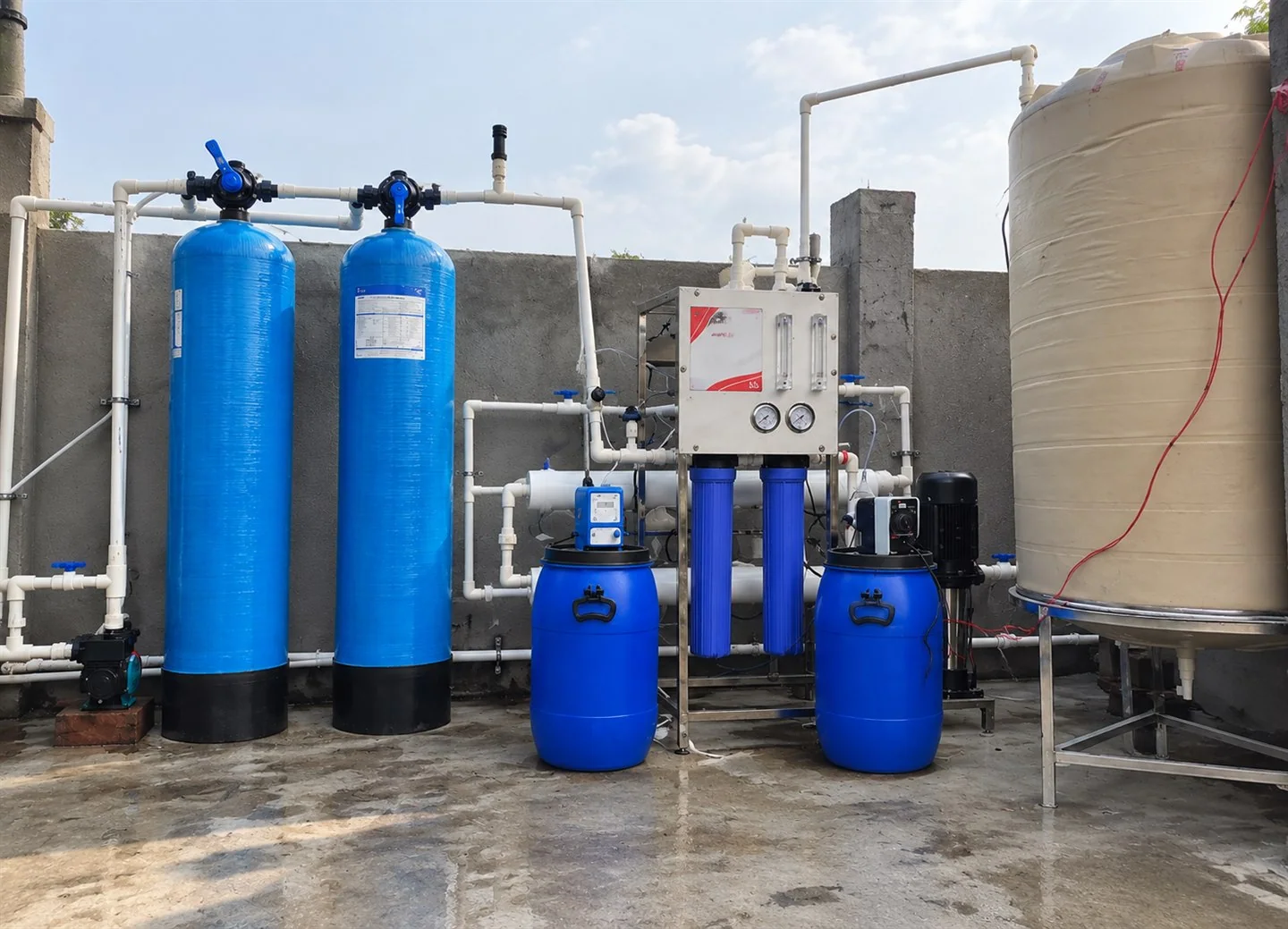
A Reverse Osmosis plant is an integrated water treatment system consisting of filtration vessels, chemical dosing equipment, pumps, membrane assemblies, storage tanks and control systems.
Each component performs a specific function in preparing raw water for membrane treatment and maintaining consistent treated water production.
4.1 Raw Water Storage Tank
The raw water storage tank collects incoming groundwater or other water sources and provides a continuous supply to the pretreatment system.
It acts as a buffer between the raw water source and the RO plant, helping maintain consistent feedwater availability.
The tank capacity is determined according to daily water demand, raw water availability and the operating schedule of the plant.
4.2 Pressure Sand Filter (PSF)
A Pressure Sand Filter is used to remove suspended particles, turbidity and other particulate impurities from raw water.
The vessel generally contains graded filtration media through which water passes under pressure. Suspended particles are retained within the media bed.
Periodic backwashing removes accumulated impurities and restores filtration efficiency.
The primary purpose of a PSF is to reduce particulate loading on downstream equipment and prevent suspended solids from reaching the RO membrane assembly. A pressure sand filter does not remove dissolved salts.
4.3 Activated Carbon Filter (ACF)
An Activated Carbon Filter uses activated carbon media to remove residual chlorine, certain organic compounds and substances responsible for undesirable taste and odour.
This stage is particularly important when chlorine is present in the feedwater because conventional thin-film composite RO membranes are sensitive to free chlorine exposure.
Activated carbon removes free chlorine through surface reactions and adsorbs selected organic substances as water passes through the media bed.
The carbon media requires periodic backwashing and replacement to maintain its effectiveness and prevent microbiological growth.
4.4 Iron Removal Filter (IRF)
Groundwater containing elevated iron and manganese may require a dedicated Iron Removal Filter before entering the RO system.
Depending on the chemical form of iron, oxidation may be necessary to convert dissolved iron into particulate forms that can be separated through filtration.
The vessel may contain suitable catalytic or specialised filtration media.
This stage helps reduce iron-related deposits, protects downstream equipment and minimises the possibility of membrane fouling.
The oxidation and filtration process is selected according to iron concentration, manganese concentration, pH and other water chemistry parameters.
4.5 Water Softener
A Water Softener reduces calcium and magnesium hardness through an ion-exchange process.
The vessel contains cation exchange resin that exchanges calcium and magnesium ions with sodium ions. Once the resin reaches its operating capacity, it is regenerated using a suitable brine solution.
Water softening is particularly useful when groundwater contains high hardness and the RO design requires additional scaling control.
By reducing hardness, the softener helps minimise calcium and magnesium-related scaling on the RO membranes. Softening does not remove all dissolved solids and is not the same as demineralisation.
4.6 Chemical Dosing System
Chemical dosing systems provide controlled addition of treatment chemicals at appropriate points in the RO pretreatment process.
Depending on raw water characteristics, the chemicals may include antiscalants, dechlorination chemicals, pH correction chemicals and other specialised conditioning agents.
Antiscalants help inhibit the formation of mineral scale on RO membrane surfaces. Dechlorination chemicals, such as sodium metabisulphite, may be used where chemical dechlorination is selected instead of activated carbon treatment.
The dosing rate is determined according to feedwater analysis, chemical characteristics and system operating conditions.
4.7 Micron Cartridge Filter
A cartridge filter provides final particulate filtration immediately before the RO membrane assembly.
It generally uses replaceable filter cartridges with specified micron ratings to capture residual fine particles that may pass through the pretreatment filters.
This stage provides additional protection against particulate fouling and helps maintain the cleanliness of the RO membrane feed channels.
Cartridge replacement frequency depends on feedwater quality and operating conditions.
4.8 High-Pressure Pump
The high-pressure pump supplies feedwater to the RO membranes at the pressure required to overcome osmotic pressure and produce permeate.
It is one of the most important mechanical components of an RO plant.
Pump selection depends on required feedwater flow, operating pressure, raw water TDS, membrane configuration, recovery and hydraulic losses.
Multistage centrifugal pumps are commonly used in industrial RO applications.
The pump must be selected according to membrane projection and actual operating requirements to maintain stable permeate production.
4.9 RO Membranes and Pressure Vessels
The RO membrane is the primary separation component of the entire system.
It consists of a semipermeable membrane structure that allows water to pass through while rejecting a significant proportion of dissolved salts and other contaminants.
Spiral-wound membrane elements are commonly used in industrial RO plants. These elements are installed inside pressure vessels designed to withstand the required operating pressure.
Depending on the application, suitable brackish water or seawater membranes may be selected.
The number of membrane elements, pressure vessels and membrane stages is determined through appropriate hydraulic calculations and membrane projection.
4.10 Permeate and Reject Water Collection
The RO membrane produces two separate streams.
Permeate is the treated water that passes through the membrane and is collected in a treated water storage tank.
Reject water, also known as concentrate, contains a higher concentration of rejected dissolved substances.
The reject stream must be managed according to its chemical composition and applicable requirements. Depending on its quality, it may be considered for suitable non-critical reuse or directed towards an appropriate disposal or treatment arrangement.
4.11 Post-Treatment System
Depending on the intended application, RO permeate may require additional treatment before use.
UV disinfection may be incorporated to inactivate microorganisms, while remineralisation and pH correction may be necessary for certain drinking water applications.
For applications requiring extremely low conductivity, additional polishing through mixed-bed ion-exchange resin or EDI may be incorporated.
The post-treatment configuration is selected according to the final water quality specifications rather than being treated as a standard requirement for every RO plant.
4.12 Electrical Control Panel and Instrumentation
The electrical control panel manages the operation of the RO plant and provides protection against abnormal operating conditions.
Instrumentation may include pressure gauges, flow meters, conductivity meters, TDS indicators, pressure switches, level switches and automatic flushing controls.
These instruments help operators monitor feed pressure, permeate production, reject flow and treated water quality.
A properly designed control system also helps protect the plant against low feed pressure, high operating pressure and other abnormal conditions.
Engineering insight / 05
5. Industrial, Commercial and Drinking Water Treatment Applications
Technochem develops Reverse Osmosis and associated water treatment systems for a wide range of industrial and commercial applications.
5.1 Industrial RO Plants
Industrial RO plants are used in manufacturing facilities requiring treated water for production processes, equipment operation and utilities.
Applications include pharmaceutical manufacturing, textile and dyeing industries, food and beverage processing, chemical manufacturing, automobile and engineering industries, electronics manufacturing and general industrial utilities.
The required permeate quality depends on the manufacturing process. Applications requiring very low conductivity may require double-pass RO, mixed-bed polishing or Electrodeionisation (EDI).
5.2 Commercial RO Plants
Commercial RO plants are designed for establishments requiring a consistent supply of purified water.
Typical installations include hotels, restaurants, hospitals, educational institutions, offices, shopping complexes, commercial buildings and institutional facilities.
The system capacity and treatment configuration are determined according to daily water demand and raw water characteristics.
5.3 Drinking Water Treatment Systems
Drinking water treatment systems are designed to reduce dissolved contaminants and address relevant microbiological water quality requirements.
Depending on the source water, the system may incorporate Pressure Sand Filtration, Activated Carbon Filtration, Iron Removal, Water Softening, Cartridge Filtration, RO Membrane Treatment and UV Disinfection.
The final treated water must be evaluated against applicable drinking water quality requirements.
5.4 BIS-Standard Drinking Water RO Systems
For drinking water applications in India, two important BIS standards are relevant.
IS 10500 – Drinking Water Specification
IS 10500 specifies acceptable and permissible limits for various drinking water quality parameters, including TDS, hardness, fluoride, iron, arsenic, chloride and microbiological contaminants.
It is used to evaluate the quality of the final treated drinking water.
IS 16240:2023 – RO-Based Point-of-Use Water Treatment Systems for Drinking Purposes
IS 16240:2023 specifically covers RO-based point-of-use drinking water treatment systems. It addresses applicable product performance, safety and testing requirements.
The BIS implementation guidelines for Amendment 1:2025 should also be considered when assessing the current standard.
An important distinction is that IS 10500 concerns drinking water quality, whereas IS 16240 addresses the covered RO drinking water treatment products.
Technochem develops drinking water treatment solutions with reference to applicable BIS requirements. Any claim of BIS certification must correspond to a valid BIS licence covering the specific product and manufacturer.
Standards references: IS 10500:2012 drinking water specification and BIS information on IS 16240:2023 point-of-use RO systems. Check applicable amendments and the licence scope for any certified product; no Technochem BIS licence is claimed here.
Engineering insight / 06
6. Specialised High-Purity Water Treatment: Dialysis and Battery Manufacturing
Certain applications require water with exceptionally low dissolved ionic content. Conventional single-pass RO may not achieve the required conductivity, making additional purification stages necessary.
Two important applications are dialysis water treatment and battery manufacturing.
Technochem develops specialised water purification configurations for these requirements using double-pass RO or mixed-bed ion-exchange polishing, depending on the required water quality.
6.1 Dialysis Water Treatment Plant
Dialysis treatment requires exceptionally high-quality water because substantial quantities of treated water are used to prepare dialysis fluid.
Water containing excessive dissolved salts, aluminium, fluoride, chloramines, heavy metals, microorganisms or endotoxins can pose serious risks to patients.
Therefore, dialysis water treatment requires a specialised purification system beyond an ordinary drinking water or commercial RO plant.
A typical dialysis water treatment configuration may include:
Raw Water Storage → Pressure Sand Filter → Activated Carbon Filter → Water Softener → Cartridge Filter → RO Treatment → Additional Purification → UV / Ultrafiltration → Dialysis Water Distribution Loop.
The primary treatment stages are explained below.
Pretreatment: Pressure Sand Filtration removes suspended particles, while Activated Carbon Filtration helps remove chlorine and chloramines. Water softening controls hardness and reduces scaling potential.
Reverse Osmosis: The RO system reduces dissolved salts and other contaminants. Depending on the incoming water quality and required specifications, a single-pass or double-pass RO configuration may be selected.
Additional Purification: Further polishing or endotoxin-retentive ultrafiltration may be incorporated to control microbiological contaminants and endotoxins.
Storage and Distribution: The treated water is supplied through a hygienically designed distribution loop to the dialysis equipment. Materials, sanitisation arrangements and circulation conditions must be selected to minimise microbial growth and biofilm formation.
Dialysis water systems must be designed and validated against applicable requirements, including the relevant ISO 23500 series and healthcare facility protocols.
Importantly, dialysis water quality is not determined by conductivity alone. Chemical contaminants, microbiological counts and endotoxin levels must also be controlled and monitored.
Technochem can develop specialised RO-based dialysis water treatment configurations based on raw water analysis, the required water quality and the specifications of the dialysis equipment.
6.2 Battery Manufacturing Water Treatment Plant
Battery manufacturing, particularly lead-acid battery production, requires highly purified water for electrolyte preparation and other manufacturing processes.
Dissolved minerals and ionic contaminants can interfere with electrolyte quality and may affect battery performance and service life.
For these applications, water with very low conductivity is required. The acceptance limit and measurement method should be specified for the battery manufacturing process, rather than inferred from the meter's display limit.
A typical battery water treatment system may incorporate:
Raw Water Storage → Pretreatment Filtration → Water Softening, where required → Cartridge Filtration → Double-Pass RO or Single-Pass RO with Mixed-Bed Polishing → High-Purity Water Storage.
Two purification configurations are commonly considered.
Option 1: Double-Pass RO System
In a double-pass RO system, the permeate produced by the first RO pass is supplied to a second RO pass for additional dissolved salt reduction. This differs from staging, where concentrate from one membrane stage feeds a subsequent stage within the same pass.
This arrangement provides substantially lower conductivity than conventional single-pass RO and may be suitable where the required water quality can be achieved through membrane treatment alone.
Option 2: Single-Pass RO Followed by Mixed-Bed Resin
In this configuration, normal RO permeate is passed through a Mixed-Bed Ion Exchange unit containing both cation and anion exchange resins.
The mixed-bed resin removes residual positively and negatively charged ions, producing water with very low conductivity.
For battery manufacturing applications, suitable mixed-bed resin such as MB6SR may be considered, subject to the manufacturer's specifications and required water quality.
The resin eventually becomes exhausted and requires regeneration or replacement.
Double-Pass RO vs Mixed-Bed Polishing
The selection depends on the required final conductivity, water production capacity, operating cost, raw water quality and maintenance requirements.
| Parameter | Double-Pass RO | RO + Mixed-Bed Resin |
|---|---|---|
| Treatment principle | Two successive membrane passes | RO followed by ion exchange |
| Dissolved ion removal | Additional membrane rejection | Polishing of residual ions |
| Chemical regeneration | Not required for membranes | Resin regeneration or replacement required |
| Operating considerations | Pressure, recovery and membrane maintenance | Resin capacity, exhaustion and replacement |
| Typical application | Higher-purity industrial water | Very low-conductivity water |
Both arrangements can be engineered to produce very low-conductivity water. The final configuration is selected according to the actual water quality specification. Demineralised water describes water with dissolved ions removed; RO with mixed-bed polishing does not produce distilled water unless a separate distillation process is used.
It is important to note that zero conductivity is not a practical absolute operating claim. The achievable value should be specified as a measurable conductivity limit, with appropriate temperature compensation and instrumentation.
For dialysis, refer to ISO 23500-3:2024 water quality requirements and the relevant ISO 23500 series. UV disinfection does not replace validated endotoxin control or chemical and microbiological monitoring. A final system requires application-specific design and validation.
Engineering insight / 07
7. How Technochem Approaches RO Plant Engineering
At Technochem, the objective is to develop a complete water treatment system based on actual raw water characteristics and the required treated water quality.
Our engineering approach begins with raw water analysis, followed by the selection of appropriate pretreatment stages.
Once the pretreatment requirements are established, the RO system is designed by determining the required feed flow, permeate capacity, membrane selection, operating pressure and recovery.
Suitable pumps, membranes, pressure vessels, filtration equipment, chemical dosing systems and electrical components are then integrated into the plant.
Depending on project requirements, additional polishing systems such as double-pass RO, mixed-bed resin or EDI may be incorporated.
The final stages include plant fabrication, installation, commissioning and evaluation of operating parameters such as pressure, flow, permeate production and conductivity.
This approach helps minimise unnecessary treatment stages while ensuring that the selected system addresses the actual water quality challenges.
Engineering insight / 08
8. Frequently Asked Questions About Reverse Osmosis Plants
Q1. What is a Reverse Osmosis plant?
An RO plant is a water purification system that uses semipermeable membranes and applied pressure to reduce dissolved salts and other contaminants in water.
Q2. Why is pretreatment necessary before RO?
Pretreatment protects RO membranes from suspended solids, hardness-related scaling, iron deposits, chlorine and other contaminants that can affect membrane performance.
Q3. Can RO plants treat borewell water?
Yes. RO plants are commonly used for borewell water purification. However, the pretreatment arrangement must be selected according to the borewell water analysis.
Q4. What is the difference between single-pass and double-pass RO?
In single-pass RO, water undergoes one membrane treatment pass, which may contain multiple stages. In double-pass RO, permeate from the first pass feeds a second RO pass to achieve additional dissolved salt reduction and lower conductivity.
Q5. What is RO plant recovery?
Recovery is the percentage of feedwater converted into permeate. For example, if a plant receives 10,000 litres of feedwater and produces 7,000 litres of treated water, its recovery is 70%.
Q6. Does an RO plant remove fluoride and arsenic?
RO membranes can reduce fluoride and certain forms of arsenic. Actual removal depends on water chemistry, contaminant form, membrane characteristics and operating conditions. Final water testing is essential.
Q7. What is a BIS-certified RO plant?
A BIS-certified RO plant is a product covered by a valid Bureau of Indian Standards licence under the applicable product standard. IS 16240:2023 covers specified RO-based point-of-use drinking water treatment systems.
Q8. Can RO water be used directly for drinking?
RO-treated water can be suitable for drinking if the complete system is properly designed and the final water meets applicable drinking water quality requirements. Additional disinfection or post-treatment may be necessary.
Q9. What is the difference between double-pass RO and mixed-bed resin?
Double-pass RO uses two successive membrane passes to reduce dissolved salts further. Mixed-bed resin uses cation and anion exchange resins to remove residual ions from RO permeate. Mixed-bed polishing is particularly useful when very low conductivity is required.
Q10. Why is specialised water treatment required for dialysis?
Dialysis water must meet stringent chemical and microbiological quality requirements because it is used to prepare dialysis fluid. A specialised treatment system incorporating RO, appropriate pretreatment, microbiological control and hygienic distribution is necessary.
Q11. What type of water is required for battery manufacturing?
Battery manufacturing, particularly lead-acid battery production, generally requires high-purity water with very low dissolved mineral content. This can be achieved through double-pass RO or single-pass RO followed by mixed-bed ion-exchange polishing, depending on the required specifications.
Q12. How do I select the right RO plant capacity?
RO plant capacity should be determined based on daily water demand, operating hours, peak consumption and required permeate quality.
Engineering insight / 09
9. Looking for an Industrial RO Plant or Specialised Water Treatment System?
Selecting the right Reverse Osmosis plant begins with understanding the available raw water and the quality of treated water required.
Whether your requirement involves an industrial RO plant, commercial water purification system, high-TDS groundwater treatment plant, BIS-standard drinking water system, dialysis water treatment plant or high-purity water system for battery manufacturing, Technochem can help develop an appropriate treatment solution.
Share your raw water analysis report, required water production capacity and intended application with our team.
Technochem – Engineering Water Treatment Solutions Around Your Requirements.
Website: Technochem water treatment solutions
Contact Technochem to discuss your raw water quality, required capacity and intended application.