Technochem is an industrial RO plant manufacturer based in Kolkata, West Bengal. Since 2012, we have designed, fabricated, installed and commissioned reverse osmosis plants for industry, institutions and commercial units across eastern and northeastern India, and in Bhutan. We start with your feed water, not with a catalogue.
An industrial RO plant uses pressure and a semi-permeable membrane to reduce dissolved salts and other impurities. Its design depends on the source water, the quality required by the process, and how much treated water the site needs.
Engineering insight / 01
What is an industrial RO plant?
An industrial reverse osmosis plant separates feed water into two streams: low-salt permeate for use or further treatment, and concentrate carrying much of the rejected dissolved material. RO is often selected when ordinary settling and filtration cannot provide the required dissolved-solids level.
Feed water is assessed through measurable parameters such as TDS, hardness, chlorides, sulphates, silica, iron, turbidity, residual chlorine, pH and temperature. Bore well, municipal, river and pond sources behave differently, so these results guide pretreatment and membrane selection.
Engineering insight / 02
How does an industrial RO plant work?
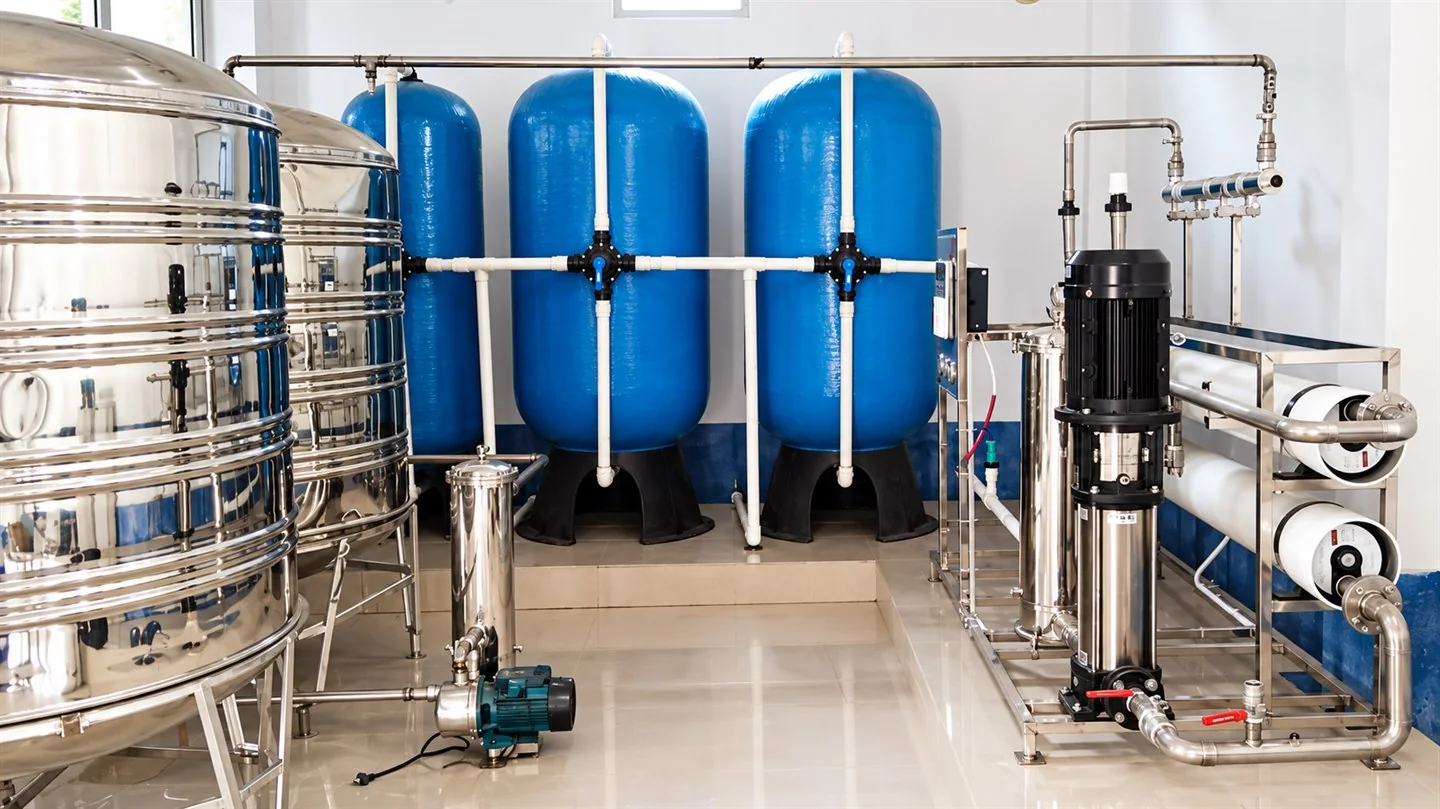
A typical treatment train prepares the water, protects the membranes, then separates permeate from concentrate. The exact stages depend on the analysis and application.
- Media filtration: sand or multigrade media reduces suspended matter and turbidity.
- Carbon filtration: activated carbon can remove residual chlorine before it reaches chlorine-sensitive membranes.
- Conditioning: softening or antiscalant dosing may control scale; a cartridge filter catches fine particles.
- High pressure: a pump drives water through the selected membrane arrangement.
- Two streams: permeate goes to storage or further treatment, while concentrate is managed separately.
Recovery and operating pressure must suit the feed chemistry. Higher recovery can reduce the reject volume but may increase scaling risk if the water chemistry cannot support it.
Engineering insight / 03
Why does RO design start with feed water analysis?
A plant designed for generic water may foul, scale or produce inconsistent water when connected to a different source. The same nominal capacity can require a different pretreatment train and membrane arrangement depending on TDS, hardness, silica, iron, chlorine and turbidity.
Analysis helps engineers identify membrane risks, select pretreatment, estimate a suitable recovery range and plan what happens to the concentrate. If source quality changes with season or borewell conditions, that variation should be considered in the design.
Key takeaway: choose the membrane design by feed water, then size the plant for demand.
Engineering insight / 04
Industries that use industrial RO plants
Industrial and commercial RO systems supply water with defined characteristics for production, utilities, cleaning and other uses. Common applications include:
- Food, beverage and dairy processing
- Pharmaceutical and process manufacturing
- Textile and other industries needing lower-salt water
- Hospitals, hotels and institutions
- Packaged drinking water operations
The required water quality comes from the application. Some projects need downstream polishing, disinfection, storage or additional treatment; these requirements should be established before selecting the plant configuration.
Engineering insight / 05
Common RO plant design problems
Many operating problems begin when pretreatment or recovery does not fit the actual feed water.
- High hardness, silica or sulphates: can contribute to scale on membranes if conditioning and recovery are not appropriate.
- Iron and manganese: can foul membranes and may need treatment ahead of RO.
- Residual chlorine: can damage many polyamide membranes; dechlorination may be required.
- High turbidity or organics: can block filters and foul membranes.
- Variable source quality: can change scaling and fouling conditions over time.
- Unplanned concentrate: creates an operational issue when its volume and route are ignored during design.
Engineering insight / 06
How to choose an industrial RO plant manufacturer
Compare how each supplier will use your feed water results and required water quality to develop the process. Ask who will handle fabrication, installation and commissioning, how the membranes will be protected, what recovery is proposed, and how concentrate will be managed.
Also clarify what operator guidance, spare parts and membrane cleaning instructions are included after start-up. A capacity figure alone does not describe plant performance or suitability.
Technochem's project approach includes understanding the requirement, reviewing water analysis, selecting the treatment process, fabricating equipment, integrating it at site and commissioning under operating conditions.
Engineering insight / 07
Industrial RO plant mistakes to avoid
- Choosing by LPH capacity without reviewing the feed water.
- Under-sizing pretreatment and exposing membranes to fouling.
- Ignoring hardness or silica while setting recovery.
- Allowing chlorine to reach chlorine-sensitive membranes.
- Leaving concentrate disposal or reuse planning until after installation.
- Using an old analysis after the water source changes.
- Comparing only purchase price without considering operation and maintenance.
- Leaving no allowance for a known increase in demand.
Most RO failures are decided at the design stage, not the operating stage.
Engineering insight / 08
Industrial RO plant maintenance tips
Routine records help operators notice changes before they become larger problems. Follow the equipment and membrane suppliers' operating guidance for the specific plant.
- Log feed and permeate flow, pressure, conductivity and temperature.
- Check chemical dosing systems and prepare solutions correctly.
- Backwash or regenerate media filters and softeners on schedule.
- Replace cartridge filters when their pressure drop indicates it is time.
- Keep chlorine from reaching membranes where dechlorination is required.
- Clean membranes when operating trends indicate it, following supplier procedures.
- Use the recommended shutdown and preservation procedure for extended stops.
- Re-test feed water when the source or season changes.
Engineering insight / 09
What affects industrial RO plant cost?
Two plants with the same nominal capacity can differ in cost because their feed water, pretreatment and output requirements differ. A useful estimate considers:
- Feed water quality and required pretreatment
- Capacity, peak demand and storage volume
- Required permeate quality and membrane arrangement
- Recovery target and concentrate handling
- Skid construction, materials and site integration
- Manual or automated controls and instrumentation
- Site access, available utilities and installation requirements
- Downstream stages such as UF, polishing or disinfection
Technochem reviews the water test report and project requirement before recommending a configuration. Actual output and recovery depend on feed quality, temperature and the selected design.
Engineering insight / 10
Frequently asked questions about industrial RO plants
What is an industrial RO plant?
It is a water treatment system that uses pressure and semi-permeable membranes to reduce dissolved salts, producing permeate and a separate concentrate stream.
How does an RO plant work?
Pretreatment reduces particles and other membrane risks, then a high-pressure pump drives water through RO membranes. Permeate and concentrate leave as separate streams.
Why does every site need a different RO design?
Feed sources differ in dissolved salts, hardness, silica, iron, chlorine and turbidity. These conditions affect pretreatment, membrane selection and recovery.
How much does an industrial RO plant cost?
Cost depends on feed water, capacity, pretreatment, required water quality, membrane arrangement, automation and site conditions. A water analysis and project requirement are needed for a meaningful proposal.
What capacities are available?
Technochem's existing product information lists nominal options of 250, 500, 1,000 and 2,000 LPH, with custom capacities for larger demand. Actual output depends on feed conditions and design.
What information should I share to discuss a plant?
Share the feed water analysis, required daily and peak flow, intended application, desired treated-water quality and site location. These details help identify the design considerations.